
This upma recipe makes classic South Indian rava upma: roasted sooji (semolina) cooked in seasoned water with ginger, curry leaves, vegetables and a spoon of ghee, until it is soft, moist and holds a gentle shape on the plate. It needs about 30 minutes and one kadai, plus a small pan to boil the water.
Upma has a bad name in many homes because it often comes out lumpy, raw tasting or stiff like cement. Three things decide the result: how well you roast the rava, how much water you use, and how you add the rava to that water. Each is explained below with exact numbers, so you can choose a softer or a more grainy upma and get it right every time.
30 minServes 3Vegetarian340 kcal
Jump to recipe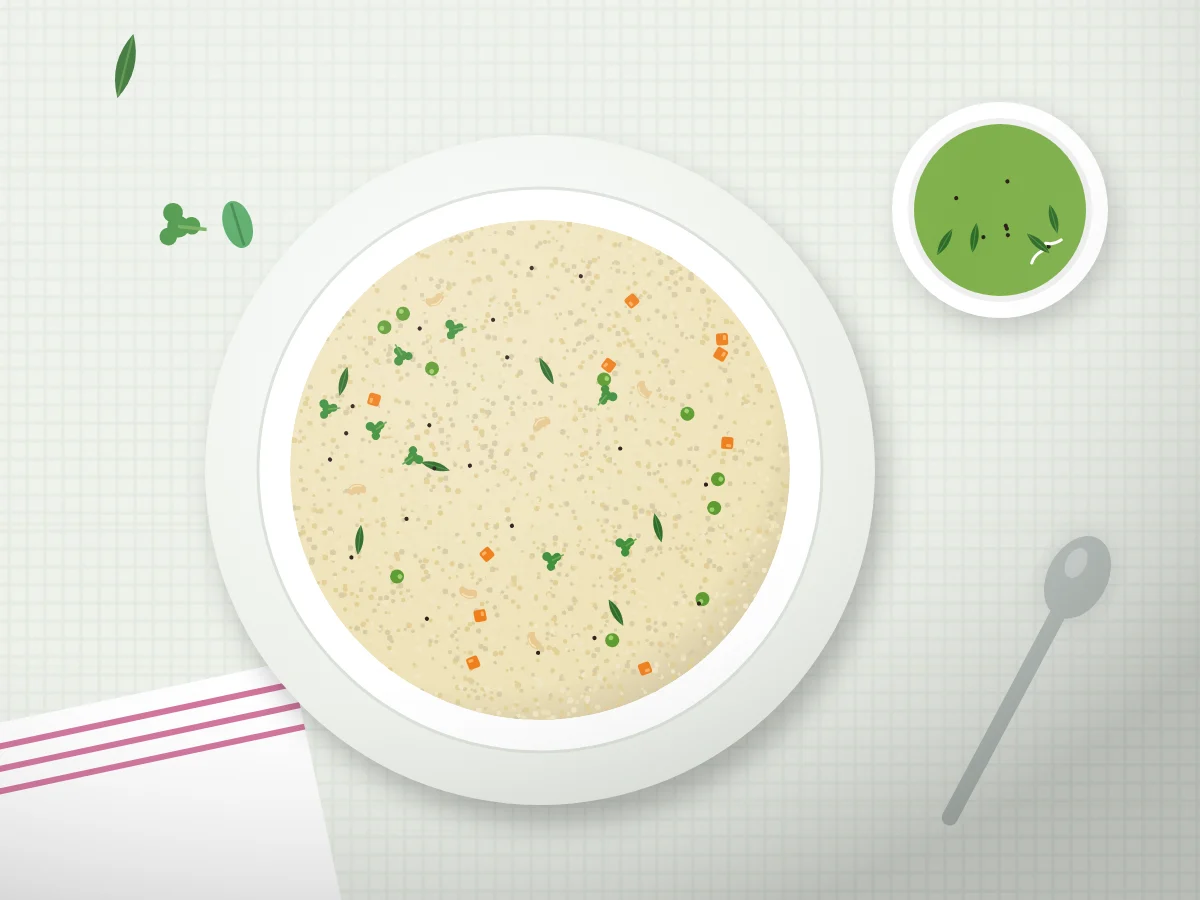
Recipe card
South Indian Vegetable Rava Upma
Roasted semolina cooked in a ginger and curry leaf tempering with vegetables, finished with ghee and lemon.
- Prep
- 10 min
- Cook
- 20 min
- Total
- 30 min
- Serves
- 3
Ingredients
Makes 3 plates
Upma
- 1 cup bombay rava (fine sooji or semolina)
- 2½ cups water
- 1 tsp saltor to taste
- ½ tsp sugaroptional
Tempering
- 1 tbsp oil
- 1 tsp rai (mustard seeds)
- 1 tsp urad dal (split black gram)
- 1 tsp chana dal (split Bengal gram)
- 8 cashewshalved, optional
- hing (asafoetida)
- 1 sprig curry leaves
- 1 inch gingerfinely chopped
- 2 green chillieschopped
Vegetables and finish
- 1 medium onionfinely chopped
- 1 small carrotfinely chopped
- 6 french beansfinely chopped
- ¼ cup green peas
- 1 tbsp ghee
- 2 tsp lemon juice
- 2 tbsp coriander leaveschopped
You will need
- Heavy kadai or wide pan
- Long spoon or whisk
- Saucepan or kettle for hot water
Method
Roast the rava
Put the rava in a dry kadai on low to medium heat. Stir continuously for 5 to 6 minutes until it smells nutty, feels light and sandy, and the grains look separate. It should stay pale cream, not turn brown. Tip it onto a plate.
Heat the water
Put the 2.5 cups water on to boil in a separate pan or kettle. Having hot water ready keeps the next steps quick.
Make the tempering
Heat the oil in the same kadai. Add mustard seeds; when they splutter, add urad dal, chana dal and cashews and fry until golden. Add hing, curry leaves, ginger and green chillies and stir for 20 seconds.
Cook the vegetables
Add the onion and cook for 2 minutes until soft. Add carrot, beans and peas and cook for 3 to 4 minutes, stirring, until the beans turn bright and slightly tender.
Add water and season
Pour in the hot water, add salt and sugar, and bring it to a rolling boil. Taste the water; it should be a little saltier than you would like the upma to be, because the rava will absorb it.
Add the rava slowly
Turn the heat to low. With one hand, pour the roasted rava in a thin stream; with the other hand, stir without stopping. Keep going until all the rava is in and no dry pockets remain. This takes about a minute.
Cover and steam
Cover the kadai and cook on the lowest heat for 3 to 4 minutes. The rava swells, the surface looks dry with tiny craters, and the upma pulls away from the sides of the pan.
Finish with ghee
Open, add the ghee, lemon juice and coriander, and fluff gently with a fork or spoon. Serve hot; upma firms up as it cools.
Tips that make the difference
- Roasted rava keeps for a month in an airtight jar. Roast a big batch on Sunday and weekday upma takes 15 minutes.
- Always add rava to boiling water, never water to rava. Pouring water onto rava is the quickest way to get lumps.
- If you want to skip cashews, double the chana dal for crunch.
- Coarse rava (upma rava or bansi rava) needs half a cup more water and 2 extra minutes of steaming.
- Use a heavy kadai. A thin pan burns the rava at the bottom before the top is cooked.
Storing: Upma sets firm as it cools. Refrigerate leftovers in a covered box for up to 1 day. To reheat, sprinkle 2 to 3 tbsp water, cover and warm on low heat for 3 to 4 minutes, then fluff.
Why roasting the rava matters in an upma recipe
Raw semolina has a floury, slightly sour taste and turns gluey the moment it meets hot water, because the starch on the surface of each grain swells at once and sticks to its neighbours. Dry roasting dries and toasts that surface. The grains then absorb water more evenly, stay a little separate, and taste nutty instead of raw.
Roast on low heat and keep stirring. You know it is done when the rava smells like warm biscuits, flows freely like sand when you tilt the pan, and a pinch rubbed between your fingers feels dry and light. Some cooks roast the rava in a teaspoon of ghee for extra flavour; that works too, but do it on even lower heat because ghee browns it faster.
Water ratio for rava upma: soft, fluffy or grainy
The single biggest choice in a rava upma recipe is the water. Use this table for 1 cup of fine sooji. Measure with the same cup for both.
| Style | Water per 1 cup rava | Texture |
|---|---|---|
| Grainy, fluffy | 2 cups | Separate grains, drier, firm when cold |
| Soft (recipe card) | 2.5 cups | Moist, holds a soft shape, good for kids |
| Very soft, hotel style | 3 cups | Almost creamy, served with a lot of ghee |
Upma made with too little water feels dry and tight in the throat, and too much makes it pasty. If you are unsure, start with 2.5 cups. Coarse rava, wheat rava (godhuma rava) and samba rava need about 3 cups and longer steaming.
The lump-free method, step by step
- Water must be at a full rolling boil when the rava goes in. Warm water lets the rava sink and clump.
- Lower the heat before adding rava, so it does not splutter and burn your hand.
- Add the rava slowly in a thin stream while stirring with your other hand. If you cannot do both, add it in four parts, stirring well after each.
- Once all the rava is in, stir for 30 more seconds and only then cover.
- If a few lumps still form, press them against the side of the pan with the back of the spoon before covering.
A whisk works well for the first 30 seconds of stirring, then switch to a spoon.
Upma variations: vegetable, semiya, oats and bread upma
Vegetable upma
The recipe card is already a vegetable upma. For a fuller veg upma, add up to 1 cup chopped vegetables in total: capsicum, tomato, sweet corn and cabbage all work. Tomato upma, popular in Tamil Nadu, adds 2 chopped tomatoes after the onion and cooks them soft.
Semiya upma (vermicelli upma)
This semiya upma recipe is the quickest of all. Use 1.5 cups roasted vermicelli and 2.25 cups water. Bring the tempering and water to a boil, add the semiya, stir, cover; it needs 4 to 5 minutes over low heat, till the water is absorbed and each strand is soft. Do not stir much, or it breaks. Any vermicelli upma recipe works best with ready roasted vermicelli. Sevai upma in Karnataka homes is made the same way.
Oats upma
Dry roast 1 cup rolled oats for 3 minutes. Make the same tempering and vegetables, add only 0.75 cup water, bring to a boil, add oats and cook covered for 3 minutes. It cooks faster than rava upma and has a softer, slightly chewy bite. More ideas on our oats recipe page.
Bread upma
A good use for day-old bread. Cut 6 slices into small cubes. Make the tempering with onion, tomato, a pinch of turmeric and chilli powder, then toss the bread cubes in for 2 to 3 minutes until they soak up the masala. Finish with lemon and coriander.
Ragi, millet and dalia upma
A ragi upma recipe uses ragi rava, and the same method suits jowar rava and foxtail millet rava. For any millet upma recipe, use 2.5 to 3 cups water per cup and cook covered for 8 to 10 minutes; millet grains need longer than semolina. For a dalia upma recipe with broken wheat, see our dalia recipe, which is cooked in a pressure cooker.
Upma in Hindi, Kannada and Marathi
Upma travels across India under different names. In Hindi homes it is suji ka upma or sooji upma, and if you are following an upma recipe in Hindi you will see suji (सूजी) for semolina, rai for mustard and kadi patta for curry leaves. The upma banane ki recipe is the same as the card above: rava bhuno (roast the rava), tadka lagao (make the tempering), pani ubalo (boil the water), dheere dheere rava dalo (add rava slowly).
In Karnataka it is uppittu, and a home uppittu recipe is often made with more vegetables and a little grated coconut, and it is served with kesari bath on the side as chow chow bath. In Maharashtra it is upit, made in the upma recipe in Marathi style with a little sugar and fresh coconut. In Kerala, upma is eaten with a ripe banana and sugar, and in Tamil Nadu with coconut chutney and sambar.
Healthier swaps for everyday upma
- Double the vegetables and keep the rava the same. You still get three plates, each with less rava and more volume than the recipe card version.
- Use 1 tsp ghee at the end instead of 1 tbsp; most of the aroma comes from a small amount added off the heat.
- Add a handful of roasted peanuts or a cup of sprouts to the tempering for some protein.
- Try wheat rava or millet rava on some days for variety; they are whole grains and keep more of the bran than bombay rava.
- Serve with a bowl of curd or sambar. Rava upma alone is mostly starch, and a side of protein balances the plate.
For breakfasts with more protein, the chillas are the better pick: moong dal chilla and besan chilla.
Fixing lumpy, sticky or hard upma
| Symptom | Why it happened | What to do |
|---|---|---|
| Lumps | Water was not boiling or rava went in too fast | Press lumps out with the spoon; add rava slower next time |
| Sticky and pasty | Rava not roasted, or too much water | Leave uncovered on low for 2 minutes to dry out; roast longer next time |
| Hard and dry | Too little water, or served cold | Sprinkle hot water, cover and steam 2 minutes |
| Raw taste | Underroasted rava | Cannot be fixed after cooking; roast until nutty |
| Burnt at the bottom | Heat too high after covering | Use the lowest flame or a tawa under the kadai |
Questions cooks ask
What is the difference between upma and poha?
Upma is made from semolina cooked in boiling water, while poha uses rinsed flattened rice that only needs a few minutes of heat. Both are quick breakfasts with a similar tempering. Our poha recipe explains how to rinse the flakes.
Which rava is best for upma?
Fine bombay rava gives the softest, most common upma. Coarse upma rava gives a more grainy texture and needs a little more water. Wheat rava and samba rava make a nuttier, more filling version.
Can I make upma without onion?
Yes. Skip the onion and add a little extra ginger and a handful of peas. Upma without onion and garlic is common for festivals and temple prasad.
How do I make upma for babies and toddlers?
Use 3 cups water per cup rava, leave out the green chilli, and skip salt entirely for babies under one year. Cook the vegetables very soft and mash the finished upma lightly. Check with your doctor about when to introduce new foods.
Why does my upma become hard after some time?
Semolina keeps absorbing moisture and firms up as it cools. For tiffin, use 3 cups water instead of 2.5 and add a little extra ghee so it stays soft until lunch.
Can I make upma in advance for a crowd?
Roast the rava and chop the vegetables ahead. Cook the upma within 30 minutes of serving, and keep it covered on the lowest heat with a sprinkle of hot water if guests are late.